ANOVA: One-way & Two-way (with Examples)
What is ANOVA?
Analysis of Variance (ANOVA) is a statistical method used to test whether the means of two or more groups are equal. ANOVA is an extension of the two-sample t-test to settings with more than two groups.
ANOVA focuses on how the total variability in a numeric outcome can be decomposed into: - Between-group variability (differences between group means), - Within-group variability (variability of observations inside the same group).
One-way ANOVA
A one-way ANOVA compares the means of a numeric variable across levels of a single categorical variable.
Example: a marketing department wants to know whether three teams have the same average sales performance.
Hypotheses
- \(H_0\): All group means are equal.
- \(H_1\): At least one group mean differs.
Assumptions (typical)
- Independent observations.
- Approximately normal residuals within each group.
- Equal variances across groups (homoscedasticity).
Example: one-way ANOVA with the poisons dataset
We use the poisons dataset:
time: survival timepoison: poison type (3 levels)treat: treatment type (3 levels)
Step 1) Import and prepare the data
library(dplyr)
library(readr)

path <- "raw_data/poisons.csv"

df <- read_csv(path, show_col_types = FALSE) |>
  # robust: drop index column only if present
  select(-any_of(c("X", "x"))) |>
  mutate(
    poison = factor(poison),
    treat  = factor(treat)
  )

glimpse(df)
## Rows: 48
## Columns: 4
## $ ...1 <dbl> 1, 2, 3, 4, 5, 6, 7, 8, 9, 10, 11, 12, 13, 14, 15, 16, 17, 18, …
## $ time <dbl> 0.31, 0.45, 0.46, 0.43, 0.36, 0.29, 0.40, 0.23, 0.22, 0.21, 0.1…
## $ poison <fct> 1, 1, 1, 1, 2, 2, 2, 2, 3, 3, 3, 3, 1, 1, 1, 1, 2, 2, 2, 2, 3, …
## $ treat <fct> A, A, A, A, A, A, A, A, A, A, A, A, B, B, B, B, B, B, B, B, B, …Step 2) Summary statistics by group
df |>
  dplyr::group_by(poison) |>
  dplyr::summarize(
    n = n(),
    mean_time = mean(time, na.rm = TRUE),
    sd_time = sd(time, na.rm = TRUE),
    .groups = "drop"
)| poison | n | mean_time | sd_time |
|---|---|---|---|
| 1 | 16 | 0.617500 | 0.2094278 |
| 2 | 16 | 0.544375 | 0.2893664 |
| 3 | 16 | 0.276250 | 0.0622763 |
Step 3) Visual check (boxplot + jitter)
library(ggplot2)

ggplot(df, aes(x = poison, y = time, fill = poison)) +
  geom_boxplot(alpha = 0.7, width = 0.65, outlier.shape = NA) +
  geom_jitter(width = 0.15, alpha = 0.6, size = 1.6, color = "steelblue") +
  theme_classic() +
  guides(fill = "none")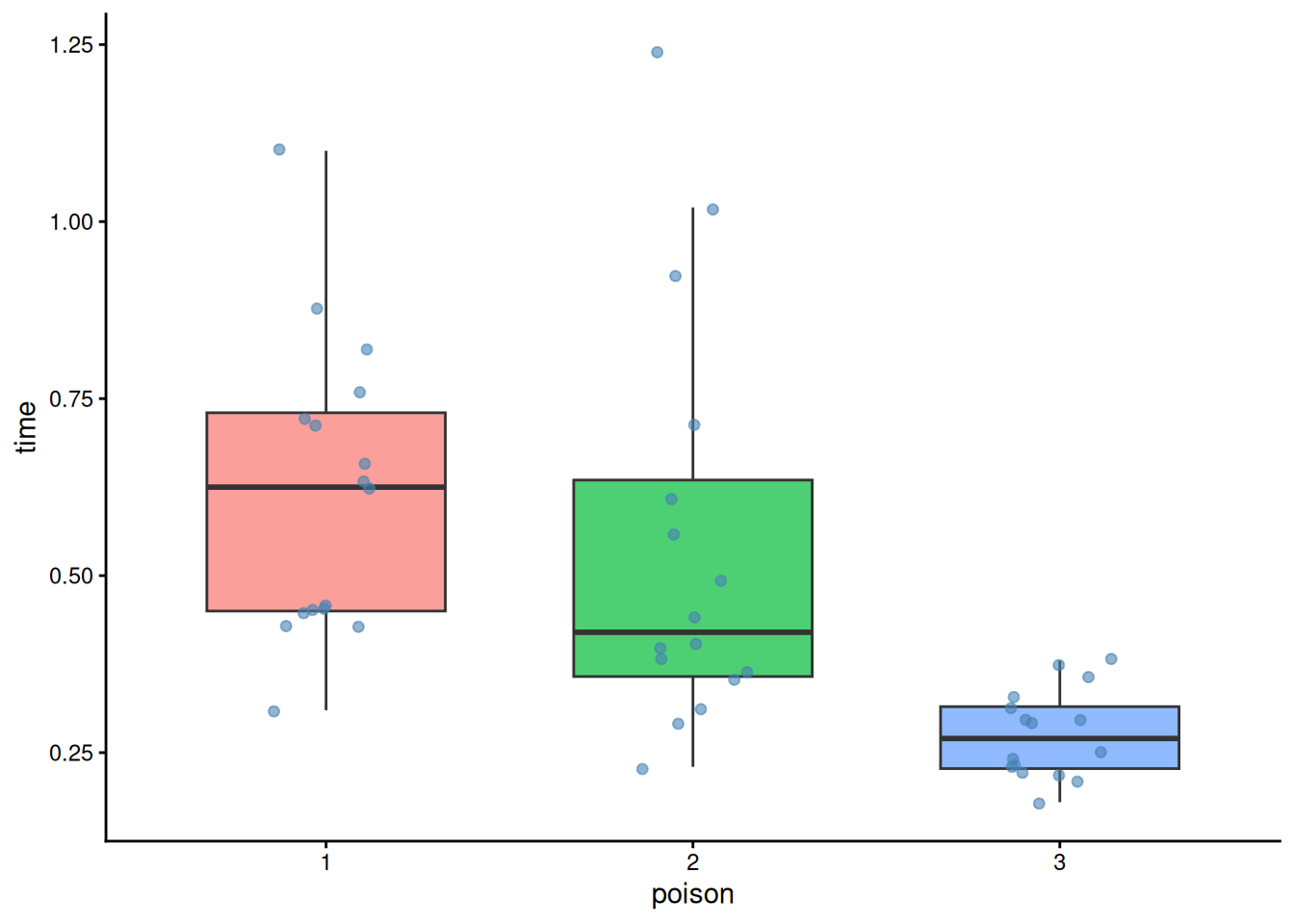
Step 4) Fit the one-way ANOVA
##             Df Sum Sq Mean Sq F value   Pr(>F)
## poison       2  1.033  0.5165   11.79 7.66e-05 ***
## Residuals   45  1.972  0.0438
## ---
## Signif. codes:  0 '***' 0.001 '**' 0.01 '*' 0.05 '.' 0.1 ' ' 1
Step 5) Post-hoc comparisons (Tukey HSD)
The ANOVA tells you whether any difference exists, but not which pairs differ. Tukey’s HSD provides pairwise comparisons with multiple-testing adjustment.
##   Tukey multiple comparisons of means
##     95% family-wise confidence level
##
## Fit: aov(formula = time ~ poison, data = df)
##
## $poison
##          diff        lwr         upr     p adj
## 2-1 -0.073125 -0.2525046  0.10625464 0.5881654
## 3-1 -0.341250 -0.5206296 -0.16187036 0.0000971
## 3-2 -0.268125 -0.4475046 -0.08874536 0.0020924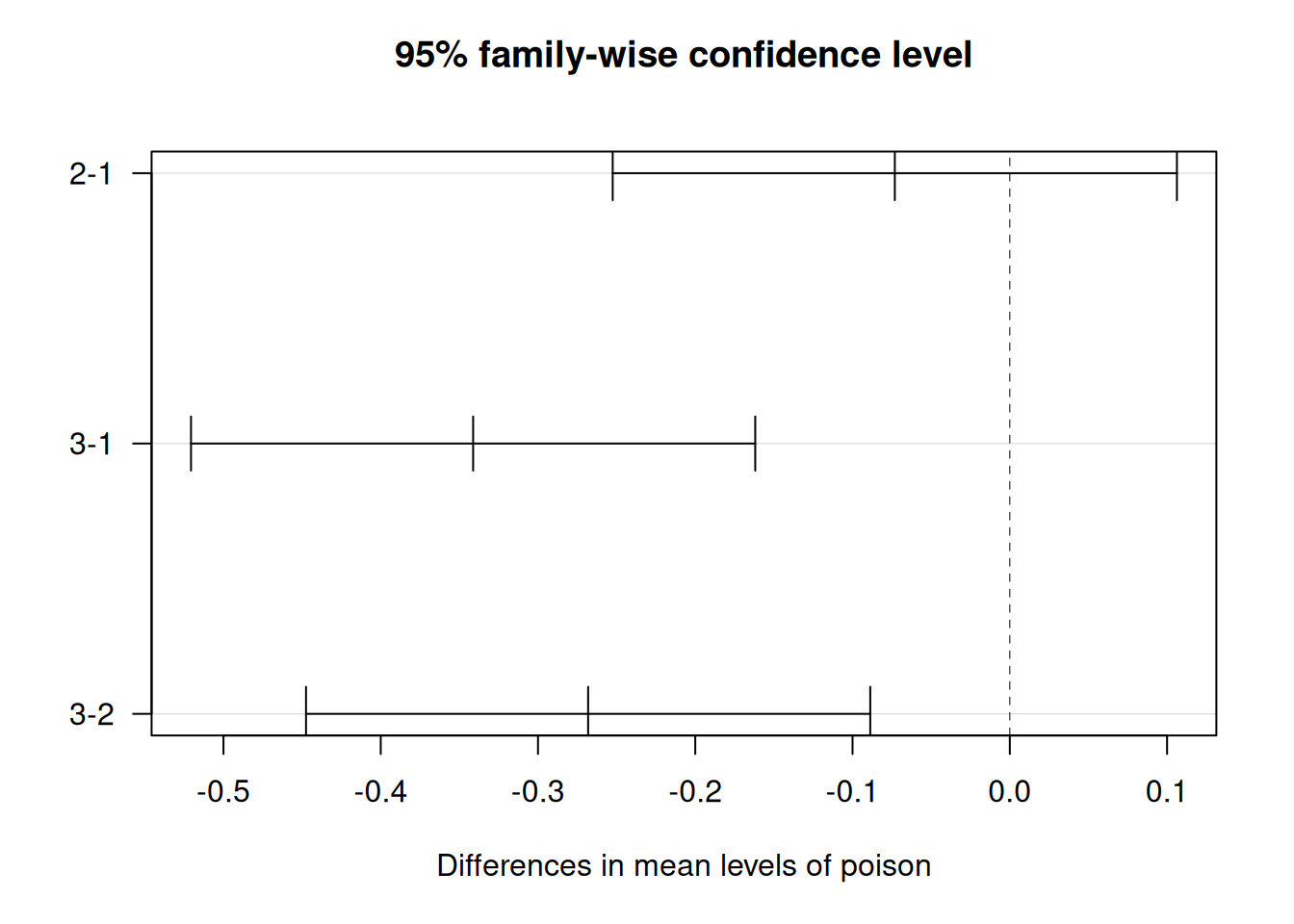
Two-way ANOVA
A two-way ANOVA includes two categorical predictors.
You typically consider: - Main effects: poison and
treat - Interaction: whether the effect of treatment
depends on poison type
Additive model (main effects only)
##             Df Sum Sq Mean Sq F value  Pr(>F)
## poison       2 1.0330  0.5165   20.64 5.7e-07 ***
## treat        3 0.9212  0.3071   12.27 6.7e-06 ***
## Residuals   42 1.0509  0.0250
## ---
## Signif. codes:  0 '***' 0.001 '**' 0.01 '*' 0.05 '.' 0.1 ' ' 1
Interaction model (recommended to check)
##              Df Sum Sq Mean Sq F value   Pr(>F)
## poison        2 1.0330  0.5165  23.222 3.33e-07 ***
## treat         3 0.9212  0.3071  13.806 3.78e-06 ***
## poison:treat  6 0.2501  0.0417   1.874    0.112
## Residuals    36 0.8007  0.0222
## ---
## Signif. codes:  0 '***' 0.001 '**' 0.01 '*' 0.05 '.' 0.1 ' ' 1
If the interaction term is significant, interpret the interaction first (effects are not constant across levels of the other factor).
Summary
| Test | Code |
|---|---|
| One-way ANOVA | aov(time ~ poison, data = df) |
| Post-hoc (pairwise) | TukeyHSD(anova_one_way) |
| Two-way ANOVA (additive) | aov(time ~ poison + treat, data = df) |
| Two-way ANOVA (interaction) | aov(time ~ poison * treat, data = df) |
A work by Gianluca Sottile
gianluca.sottile@unipa.it